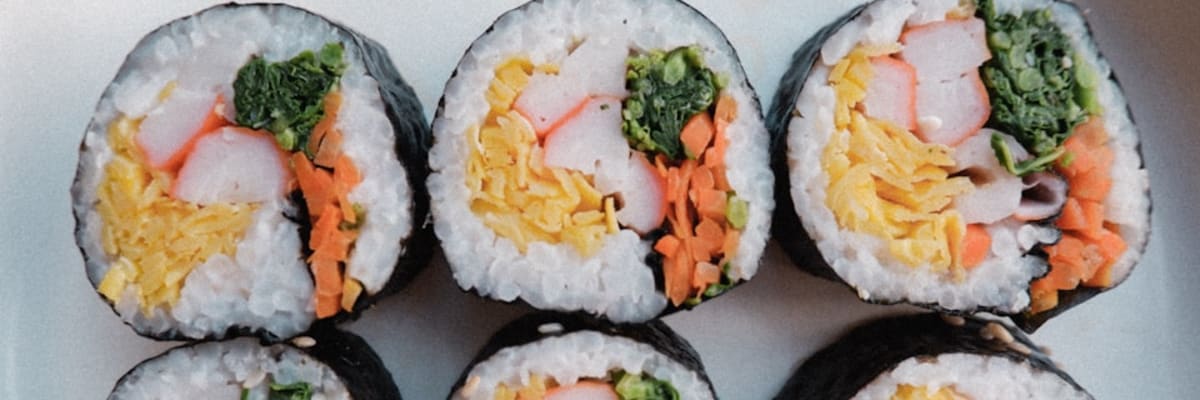
I was scrolling Instagram and saw Chef Edward Lee’s post about gimbap. He visited 14 different places in Seoul and called gimbap “works of culinary art.” Meanwhile, I’m over here thinking about the 3,000 won triangle gimbap from the convenience store that I demolished at 2 AM last week. But he’s not wrong - gimbap IS art. Just… accessible, everyday, democratic art that costs less than a coffee.
What Chef Edward Lee Discovered About Gimbap
Chef Edward Lee (you know, from Culinary Class Wars) recently went on a gimbap tour of Seoul and documented 14 different types. His caption hit different:
“Gimbap is a versatile Korean rice and seaweed roll that can be filled with endless flavors. I’ve always thought of it as a quick snack but these beautiful variations have made me rethink them as works of culinary art.”
He went from Jeyuk Gimbap (spicy pork) at casual spots to Bakgane Yukhoe (raw beef tartare gimbap with raw egg) at Gwangjang Market. From trendy Otto (leafy, healthy versions) to old-school Mohtoongi (red bean rice gimbap with fermented rice drink).
And you know what? His favorite was Woorijip’s hairtail fish gimbap - “just roasted hairtail fish and too much rice” but somehow the best one.
That’s the thing about gimbap. It doesn’t need to be fancy to be perfect.
What Gimbap Means to Koreans
김 (gim) = seaweed 밥 (bap) = rice
For Koreans, gimbap isn’t just food. It’s:
1. Childhood Picnic Food
Korean moms make gimbap for school field trips, family outings, road trips. There’s something about unwrapping foil to reveal perfectly sliced gimbap rolls that just hits different.
(Real conversation in every Korean household)
2. Late Night Survival Food
Convenience stores are EVERYWHERE in Korea. Open 24/7. Gimbap is always there. 1,500-3,000 won. Sometimes that’s all you need.
3. Budget Meal
Students live on gimbap. One roll + free broth at 김밥천국 (Gimbap Heaven) = full meal under 5,000 won.
4. Hangover Cure
After a night of soju, gimbap with kimchi from the convenience store somehow makes everything better. Don’t ask me why. It just works.
5. Bus Food
Taking an express bus? Everyone brings gimbap. The whole bus smells like sesame oil and pickled radish. It’s comforting.
Edward Lee’s 14 Gimbap Discoveries
Let me break down some highlights from his Seoul gimbap tour:
The Classic Ones
Jeyuk Gimbap (제육김밥) His “OG version” - spicy pork, carrot, egg, pickled radish. This is what you find at every 분식집 (bunsikjip - Korean snack restaurant). The baseline. The standard.
Yeonhui Gimbap (연희김밥) Multiple locations in Seoul, made fresh all day. Edward loved their spicy squid version. This place always has a line.
Tong Tong Gimbap (통통김밥) Near Namdaemun, always a wait, tiny stall. He called it “the best version of spicy anchovy gimbap.” When a Michelin-level chef waits in line, you know it’s good.
The Market Finds
Ggoma Gimbap (꼬마김밥) At Mangwon Market. 꼬마 means “little child” - these are mini rolls perfect for munching while shopping. Korean market culture at its finest.
Bakgane Yukhoe (박가네육회) Inside Gwangjang Market. Raw beef tartare gimbap with raw egg and soy sauce on the side. This is NOT your convenience store gimbap.
The Trendy Ones
Teacher Kim (티쳐킴) Keto gimbap made with egg instead of rice. Edward was skeptical but the shrimp version converted him. This is peak Korean food innovation - taking tradition and flipping it.
Otto (오또) Trendy chain making fresh, leafy gimbap that’s healthier than standard versions. Very Instagram-worthy. Very 2020s Korea.
The One That Rules Them All
Woorijip (우리집) Just roasted hairtail fish and “too much rice” but Edward said: “Maybe my favorite one of all.”
Sometimes the simplest version wins. That’s gimbap.
Chungmu Gimbap: My Personal Favorite
Edward Lee mentioned this one (#7 on his list) and I NEED to talk about it because 충무김밥 is the best gimbap style and I will die on this hill.
What Makes It Different
Normal gimbap: Everything rolled inside - vegetables, egg, protein, all mixed together.
Chungmu gimbap:
- Tiny rice rolls with JUST seaweed and rice
- Spicy squid served on the side
- Radish kimchi (무김치) on the side
- You eat them together
Why It’s Superior
- The rice stays perfect - Not soggy from moisture
- You control the ratio - Want more squid? More kimchi? Your call
- The flavors stay distinct - Nothing gets muddled
- It’s made to order - Fresh, not sitting in a fridge
Edward said it right: “super fresh and addictive.”
Where It Comes From
충무 (Chungmu) is the old name for Tongyeong, a coastal city in South Korea. Fishermen’s wives made these simple rice rolls because they wouldn’t spoil in the heat. The seafood was served separately.
Now it’s everywhere in Korea, but coastal cities still make it best.
분식집 Culture: Where Gimbap Lives
분식 (bunsik) = flour-based food / snacks 집 (jip) = house/restaurant
분식집 is where Koreans eat gimbap. These are casual restaurants that serve:
- Gimbap (김밥)
- Tteokbokki (떡볶이) - spicy rice cakes
- Ramyeon (라면)
- Sundae (순대) - blood sausage
- Fried foods (튀김)
The Vibe
- Cheap (most items under 5,000 won)
- Fast (food comes in 5 minutes)
- Casual (you order at the counter, self-serve water)
- Comforting (fluorescent lights, plastic chairs, free broth)
김밥천국 (Gimbap Heaven)
This is the most famous 분식집 chain. Not fancy. Not trendy. Just… reliable.
What you get:
- Multiple gimbap varieties (참치, 치즈, 김치, 제육)
- Prices: 2,500-4,000 won per roll
- Free soup/broth at the table
- Fast service
- Open late
When I’m too tired to cook, too broke for a real meal, or just craving something familiar - 김밥천국 is there.
Types of Gimbap You’ll Find
The Classics
야채김밥 (Yachae Gimbap) - Vegetable Carrot, spinach, pickled radish, egg. The basic.
참치김밥 (Chamchi Gimbap) - Tuna Canned tuna mixed with mayo. Don’t judge until you try it.
김치김밥 (Kimchi Gimbap) Kimchi inside. Sometimes fried. Always good.
제육김밥 (Jeyuk Gimbap) - Spicy Pork Edward Lee’s OG favorite. Spicy, savory, perfect.
치즈김밥 (Cheese Gimbap) Cheese inside. Kids love it. Adults secretly love it too.
The Fancy Ones
소고기김밥 (Sogogi Gimbap) - Bulgogi Marinated beef. More expensive but worth it.
돈까스김밥 (Donkkaseu Gimbap) - Pork Cutlet Crispy fried pork cutlet rolled inside. Filling, satisfying, and weirdly perfect.
묵은지김밥 (Mugeunji Gimbap) - Aged Kimchi Made with well-fermented kimchi (묵은지) that’s been aged for months. Sour, deep, and punchy. The kimchi flavor hits totally different when it’s been sitting that long.
계란말이김밥 (Gyeranmari Gimbap) Wrapped in egg omelet instead of seaweed. Like Edward saw at Jinsunja.
누드김밥 (Nude Gimbap) Rice on the outside, seaweed on the inside. Why? Because we can.
The Convenient Store Ones
삼각김밥 (Samgak Gimbap) - Triangle Gimbap Onigiri-style. Grab and go. Perfect for buses, trains, drunk nights.
Gimbap vs Sushi: Let’s Settle This
People always compare them. Here’s the difference:
| Aspect | Gimbap | Sushi |
|---|---|---|
| Rice | Seasoned with sesame oil + salt | Seasoned with rice vinegar + sugar |
| Fillings | Cooked vegetables, egg, meat | Raw fish (usually) |
| Purpose | Meal, snack, picnic food | Special occasion, restaurant food |
| Price | Cheap (2,000-5,000 won) | Expensive (10,000+ won) |
| Taste | Savory, sesame flavor | Slightly sweet, tangy |
| Eating | Cut into slices, eat with fingers | Often with chopsticks, wasabi/soy |
Bottom line: Gimbap is everyday food. Sushi is an event. Both are good. They’re just different.
Don’t call gimbap “Korean sushi.” It’s gimbap.
How to Eat Gimbap Like a Korean
1. Eat it fresh
Gimbap is best within 2-3 hours of being made. The rice gets hard in the fridge.
2. Use your hands
Chopsticks work, but hands are better. It’s finger food.
3. Pair it with soup
분식집 gives you free broth. Sip between bites. The hot + cold combo is perfect.
4. Dip it (optional)
At 분식집, some people dip gimbap in tteokbokki sauce (떡볶이 소스). The spicy-sweet combo is surprisingly good. Don’t dip in soy sauce though - that’s not a thing.
5. Don’t overheat it
If you microwave gimbap, do 10-15 seconds MAX. Just to take the chill off. Don’t cook it.
Where to Find Good Gimbap
In Korea
분식집 (Bunsikjip):
- 김밥천국 (Gimbap Heaven)
- 죠스떡볶이 (Jo’s Tteokbokki)
- Any neighborhood 분식집
Markets:
- Gwangjang Market (광장시장) - 육회김밥
- Mangwon Market (망원시장) - 꼬마김밥
- Namdaemun Market (남대문시장) - 통통김밥
Convenience Stores:
- GS25
- CU
- 7-Eleven
- Emart24
All sell 삼각김밥 and sometimes regular rolls.
Outside Korea
Korean grocery stores often have a deli section making fresh gimbap daily.
Korean restaurants might have it on the menu, but it’s hit or miss.
Make it yourself - It’s easier than you think. Rice + seaweed + whatever you want inside.
Edward Lee’s Final Note
He ended his post by mentioning his own version at GS25: spicy pulled pork bbq gimbap. A Korean-American chef bringing American BBQ flavors into Korean gimbap, sold at a Korean convenience store.
That’s the beauty of gimbap. It’s infinitely adaptable. You can put ANYTHING in it and it works.
Traditional? Trendy? Fusion? Keto? Raw beef? Hairtail fish with too much rice?
All valid. All gimbap.
My Experience
I’ve eaten gimbap in every possible context:
- School field trips - Mom woke up at 5 AM to make 20 rolls
- Late night - 2 AM convenience store runs after studying
- Hungover - The only thing that sounded edible
- Road trips - Eaten in the back seat, foil wrapper everywhere
- Quick lunch - 분식집 near work, in and out in 15 minutes
But my favorite will always be 충무김밥.
My husband’s grandmother is from Tongyeong (통영), the birthplace of Chungmu gimbap. When we visited her hometown, I tried the original 원조 충무김밥 for the first time. It was nothing like the versions in Seoul.
The rice was still warm. The squid was so fresh it tasted like the ocean. The radish kimchi had this perfect crunch. I ate three servings.
That’s when I understood - 충무김밥 isn’t just gimbap. It’s Tongyeong’s soul food.
Now whenever I eat Chungmu gimbap in Seoul, I’m chasing that memory. My husband thinks I’m weird for loving the “boring rice rolls” but he doesn’t get it. 충무김밥 just hits different.
When Edward Lee mentioned it on his list, I felt SEEN. Like, yes, finally someone gets it.
Gimbap isn’t just a quick snack. It’s not just cheap food. It’s comfort. It’s childhood. It’s late nights and early mornings. It’s Korean life, rolled up in seaweed.
And maybe that IS culinary art.
Related Posts
다음에 한국 가면 충무김밥 꼭 먹어봐. 그냥 김밥이 아니야 - 이건 경험이야.
(Next time you’re in Korea, try Chungmu gimbap. It’s not just gimbap - it’s an experience.)
Source: @chefedwardlee Instagram